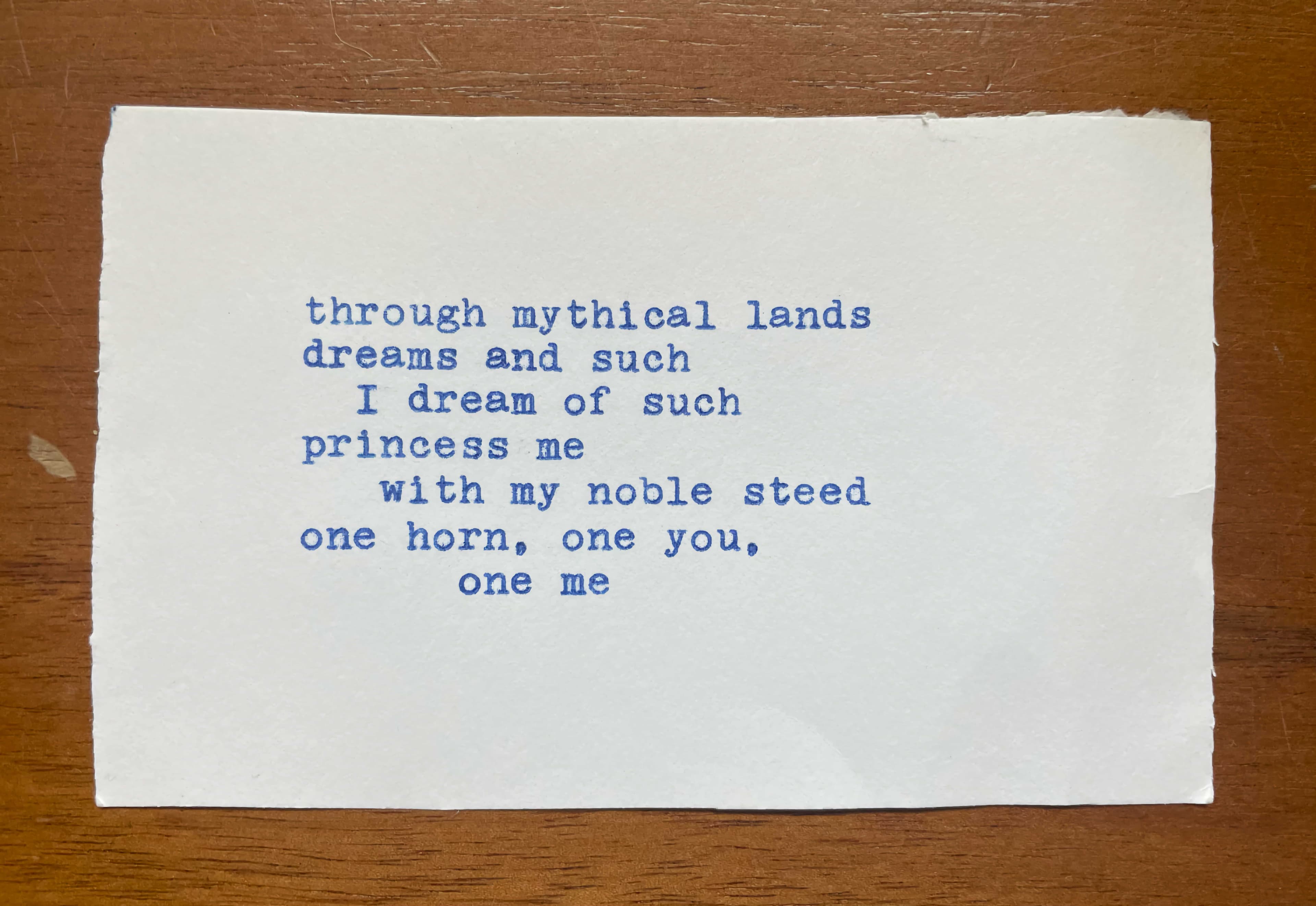
At the Main Street market on Saturday morning, a hippie about my age set up on the sidewalk with a folding chair and a small table barely large enough to hold his typewriter.
His shingle was a clean-cut square of hardwood scrap, about eight inches across. Hand-painted letters described him, not his wares: Street Poet.
We walked past, but I had already felt the magnet-pull of words beneath the surface, so the stroller wheeled around in the crowd. “That looked like an interesting man. Let’s go learn more about him.”
“Are you a writer?” my son asks without introduction.
“I’m a mechanic mainly, but sometimes I’m a writer.”
“My dad’s a really good writer.”
“Is that so?”
The Street Poet eyes me, half-knowing, half-asking, and my son rescues me from his innocent betrayal.
“What do you do with the typewriter?”
“I write poems for people who need a poem.”
“Is that hard?”
“Yes, but I’m pretty good at it. Do you want a poem?”
My son hesitates. He wants a poem, but he’s not sure he wants it to be his. Quick on his feet, he respectfully demurs, giving away the cake, but still guaranteeing himself a slice:
“She wants one,” he says, looking down the length of his arm, past his forefinger, at his youngest sister, aloof in the stroller.
The Street Poet’s gaze follows the same path, considers the child, then rises slowly up to mine. His eyebrows arch almost imperceptibly; he waits.
I hold his stare as the pen in my mind finds the inkwell and starts to knit my brow.
“She wants a poem about a unicorn,” I blurt out, too definitively.
My son squints his eyes and cocks his head. I empathize with him and feel apologetic: the choice is tragically stereotypical, and doubly so for a writer he claimed. But he can’t see that in my heart, I am testing the Street Poet.
After loading a small, hand-cut card of paper into the writing machine, the poet closes his eyes. Writers know this moment: he is looking for the muse. He is leaning upon hundreds of thousands of keystrokes of expression, searching for a current that will join the waves of imagination and moment. His eyes are shut so he can see behind the things he can see.
A moment later, he wakes up—alert—and begins striking keys using only his muscled index fingers. The typing is primitive, but precise, the sure movement of hands that earn their bread with tools.
My children are surprised by the mechanical staccato issuing from the machine, and begin to pepper the Street Poet with questions about his contraption. My first instinct is to feel sorry for an artist caught between the need for fertile solitude, the demand to deliver, and a sudden inquisition; this is no writer’s hideout. But I watch him steadily commit to each word as the wave rises, and I realize that this is a choice, that it shapes the poems, that it is a crucible for his other writing. I somehow feel shorter than him, even though he is sitting and I am standing.
He pecks, considers, pecks, pauses. It’s ink, and there is no delete button.
After several minutes, the silence lingers and he leans back, creaking the chair. He seems alone as he considers his work, and smiles.
He pulls the card out of the typewriter and hands it to a child he knows can't read. This is heroic, and I hope my children remember long enough to understand why.
She hands the card to me. I read it out loud for her, for the Street Poet, and for myself.
My daughter smiles, my son smiles, and the Street Poet is still smiling, but at me. I dig a few crumpled bills out of my wallet to drop in the open case on the ground, but we both know I'm teaching manners, because the poet has already been paid in full.